Brand Identity Design: What Makes a Mark Last Beyond Trends
The most common mistake in brand identity projects isn't a bad logo. It's starting with the logo. Clients arrive asking what their mark should look like before anyone has agreed on what the brand needs to say, who it's talking to, or what it should feel like to encounter it for the first time. Visual identity is the last decision in a good brand process — it's the output of a long sequence of strategic choices that most projects skip entirely.
Skip that sequence and you get a logo that looks fine in the presentation, works in the brand guidelines PDF, and starts feeling wrong about eighteen months after launch. Not because the design was bad — because it had nothing underneath it.
A Logo Is a Mark. An Identity Is a System.
This distinction sounds academic until you're looking at a brand that isn't working and trying to figure out why. The logo might be good. The individual pieces might be well-designed. But the brand feels inconsistent, weightless, forgettable — and the reason is almost always the same: there's no system underneath it.
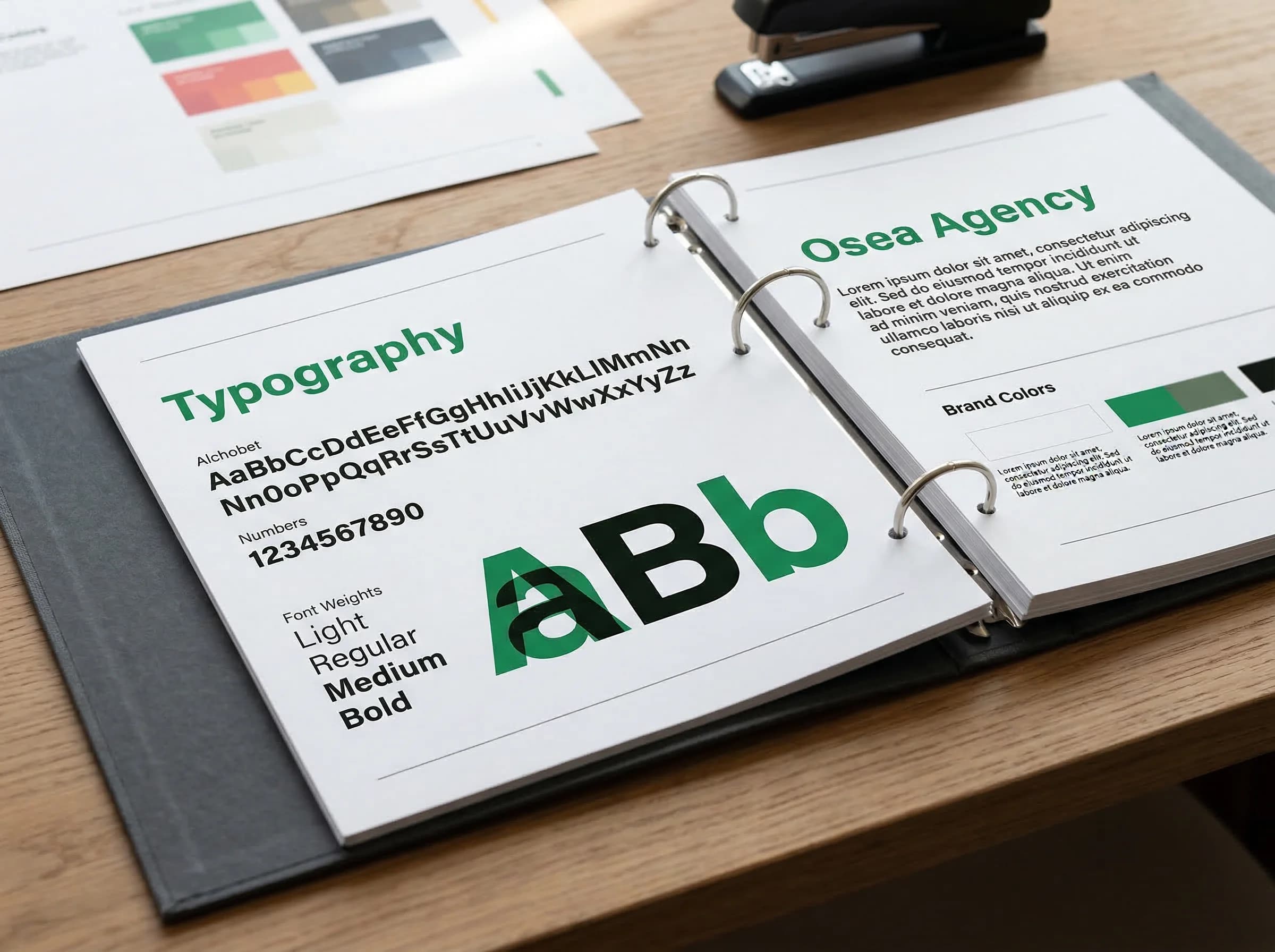
A brand identity system is the full set of visual and verbal rules that govern every touchpoint: logo usage, typography, color palette, spacing, photography direction, tone of voice, and how all of these interact with each other across different formats and contexts. When that system is built well, the brand becomes recognizable even when the logo isn't visible. The typography alone, or the color, or the way images are framed — any one of these should be enough to identify the brand without the mark.
That's not an accident. It's the result of deliberate, consistent decisions applied across every surface over time. It's also why strong brand identity design is harder than it looks from the outside — and why getting it right at the start is worth the investment.
“A brand is not what you say it is. It is what they say it is.”
— Marty Neumeier
What Strategy Actually Does Before Design Starts
Brand strategy is the part of the process that most clients want to skip. It takes time, it doesn't produce anything they can show a colleague, and it can feel like a delay before the work they actually hired you for. But the strategic phase is where the design decisions get made — they just don't get drawn yet.
Who is this brand for, and what does that audience already believe about this category? What do competitors look like — not so the new brand can avoid them, but so it can consciously occupy different visual and emotional territory? What does the brand need to feel like at first contact — before the copy is read, before anyone knows the company name? What is the one thing the identity needs to communicate, and what would immediately undermine that?
These questions don't have obvious answers. They require research, honest conversation, and sometimes some pushback on what the client thinks they want. But when they're answered well, the design brief that comes out of the process is specific enough to make design decisions by — which means fewer rounds, less subjective feedback, and an outcome the client can defend to their own team because they understand the reasoning behind it.
Our approach to brand identity always starts with this phase. What we build visually is downstream of what we agree on strategically. If you want to see what that looks like in practice, the Andes Adventure Visuals case study walks through how strategic decisions shaped every visual choice in that project.
What Makes a Mark Last
Marks that endure don't share an aesthetic — they share a set of structural qualities. Look at the logos that have stayed largely unchanged for decades. They're not all minimal. They're not all bold. They don't follow a single design trend. What they have in common is internal logic: every element of the mark is there for a reason, and the reasons are connected to something real about the organization.
Simplicity at scale is one quality — the mark has to work at 16px on a browser tab and at three meters on a building facade without losing its form or its meaning. Contrast independence is another: a mark that only works in full color on a white background is a fragile mark. It needs to work reversed, in single color, embossed, engraved, and stitched onto fabric before it can be trusted across real-world applications.
Rooted meaning matters more than most designers talk about. A mark that connects to something specific about the organization — its name, its origin, its operating principle — accumulates meaning differently than one that's generically professional. Generic professional logos look fine on day one and feel hollow on day three hundred, because there's nothing underneath the surface to discover.
Finally, systematic flexibility: the mark needs to extend into a wider system — a monogram, a pattern, an icon, a sub-brand — without losing coherence. If extensions require inventing new rules each time, the system isn't strong enough. A well-built identity system almost designs its own extensions because the logic is clear.
Color Is a Competitive Tool, Not a Decorative Choice
Color is the most emotionally immediate element in a brand identity, and one of the most frequently mishandled. The common failure mode is reaching for what looks current — a particular shade of warm beige, an earthy terracotta, a muted sage green — without asking whether it actually owns any space in the competitive landscape.
We start color decisions with a competitive audit: what colors do the main players in this category use, and what does the palette map look like? If the sector is dark navy and gold, stepping into a clear, unexpected palette — something with energy, or warmth, or precision — immediately separates the new brand from everything around it. Contrast is a strategic asset. A brand that looks like its competitors has to compete on every other dimension, including price.
Color also carries cultural weight that shifts across markets. We work with clients across Algeria, the MENA region, and internationally, and the same palette can land very differently in Algiers than it does in London or Dubai. This isn't an obstacle — it's information that shapes how the identity is deployed across different regions, and it's a reason to think carefully about color early rather than treating it as a finish.
Typography Does More Work Than You Think
A typeface communicates before a single word is read. A high-contrast serif carries authority and history. A geometric sans-serif reads as modern and precise. A humanist sans-serif feels warm and approachable. These aren't absolute rules — but they're strong default associations that the audience brings to any brand encounter, and a type choice that fights those associations has to work harder to land correctly.
The primary typeface handles expression: it's in the headlines, the key messaging, the moments where the brand is speaking with its fullest personality. The secondary typeface handles utility: body copy, long reads, data, interface text. They should feel related — part of the same sensibility — but they don't need to match. A sharp display serif with a clean neutral sans at body size is a combination that shows up in a lot of strong brand systems for a reason: it works.
For brands operating across Arabic and Latin scripts — something we handle on several projects — type decisions get more complex. The typefaces need to feel consistent in weight and character even when the letterforms are completely different. This is an area where a lot of identities fall apart in the MENA market: the Arabic version of the brand looks like a translation rather than a native expression of the same identity.
When to Rebrand — and When Not To
Not every brand that looks dated needs a full rebrand. Sometimes the underlying identity is sound but inconsistently applied — the logo is fine, the colors are right, but no one has enforced the guidelines for two years and everything has drifted. In those cases, the fix is a visual audit and a re-commitment to the system, not a new mark.
A rebrand makes sense when the identity no longer reflects what the business actually is — when the company has grown, pivoted, or repositioned and the brand is still telling the old story. It also makes sense when the identity is so generic that it provides no competitive differentiation and no emotional hook for the audience it's supposed to attract.
What it shouldn't be is a response to boredom. Internal familiarity breeds a kind of blindness — the team sees the logo every day and stops registering it, which can feel like the logo is invisible to everyone. Usually it isn't. Audiences need to see a brand identity far more times than the team does before recognition builds. Rebranding too early resets that clock for no return.
Getting the Foundation Right
Brand identity design done well is not a luxury for large companies with large budgets. It's a competitive advantage available to any business willing to think carefully before reaching for design tools. The marks that last are not the most elaborate or the most expensive — they're the most considered. They were built on clear answers to hard questions, and the design reflects those answers at every level.
Our brand identity service covers the full process, from positioning and strategy through visual identity system and final deliverables. If you want to understand what that process looks like for a specific type of project, the best place to start is our portfolio — or get in touch directly and we'll have a straightforward conversation about what your brand actually needs.
More from the blog
Mar 17, 2026·7 min read
Minimalist Logo Design: Why Simple Isn't the Same as Easy
Everyone wants a clean, minimal logo. Very few brands get one that actually works. The difference isn't aesthetic — it's strategic. Here's what separates a minimal logo from an empty one.
Fouad Boukra

Mar 17, 2026·6 min read
Next.js vs WordPress: Why We Don't Build on WordPress
WordPress powers 43% of the web. Most of those sites are slow, bloated, and quietly costing their owners business. Here's what we use instead — and why it matters for your bottom line.
Fouad Boukra
Mar 5, 2026·7 min read
Web Design Principles: 5 Rules We Never Break on Any Project
After hundreds of pages and dozens of projects across three continents, certain principles have proven non-negotiable. Not because we decided they should be — because every project that ignored them paid for it.
Fouad Boukra