Minimalist Logo Design: Why Simple Isn't the Same as Easy
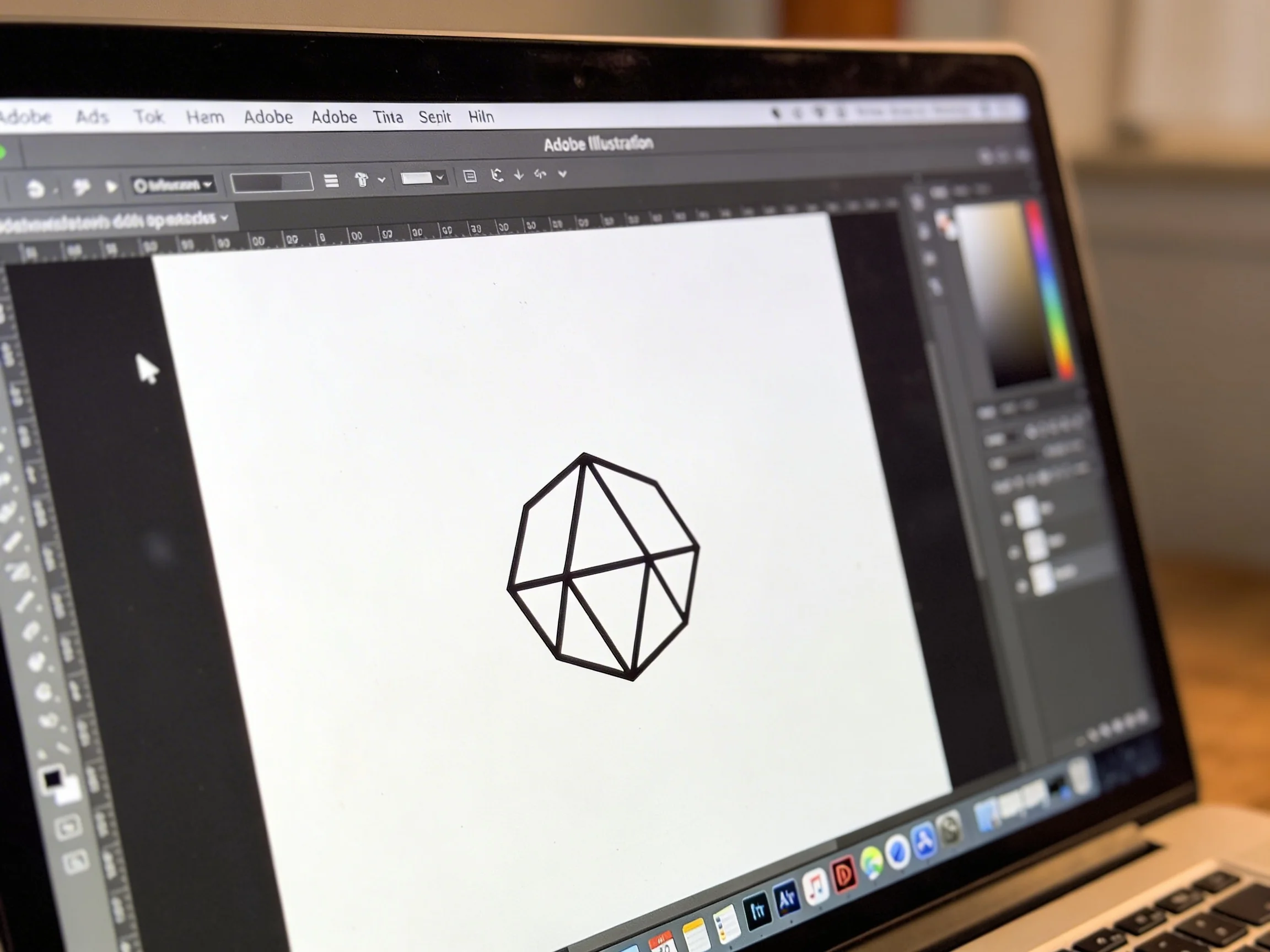
Every client who comes to us for a logo says some version of the same thing: 'I want something clean and minimal.' They show us Apple. They show us Nike. They show us a mood board of geometric marks on Behance that all look vaguely the same. And then they're surprised when the logo their last designer made — technically minimal, technically clean — feels flat and forgettable.
Minimalism is the most misunderstood direction in logo design. Not because it's complicated — because it looks simple. And anything that looks simple is assumed to be easy to get right. It isn't. A minimalist logo is one of the hardest deliverables in branding precisely because there's nowhere to hide. When you strip away decoration, what's left either holds meaning or it doesn't.
What Minimalist Logo Design Actually Means
A minimalist logo isn't defined by how few elements it uses. It's defined by how much meaning it packs into what remains. The goal isn't subtraction — it's distillation. You're not removing things until the logo looks clean. You're removing things until nothing important is missing.
The functional advantages are real and worth understanding. A minimal mark scales without degrading — it reads on a 16x16px favicon and on a three-meter exhibition banner. It reproduces cleanly in single color, which matters for embroidery, engraving, and print contexts most businesses don't think about until they're already locked in. It loads fast as an SVG. It works on dark and light backgrounds without needing two separate versions of itself.
These aren't aesthetic preferences — they're practical constraints that minimal design happens to solve well. But a logo that ticks all those boxes and communicates nothing about the brand isn't a good logo. It's a placeholder with a color.
The Strategy That Has to Come First
This is where most minimal logos fail, and it's not the designer's fault — it's a process problem. A logo is designed before the brand strategy is clear. The brief is vague ('professional, modern, trustworthy'), so the designer solves for aesthetics instead of meaning, and the result is technically competent and strategically empty.
Before a single shape is drawn, the right questions are: Who is this brand for, specifically? What does this brand need to feel like in that audience's context? What should this logo communicate at a glance — not in a paragraph, at a glance? And what would immediately disqualify this logo from doing its job?
Those answers constrain the design space in a useful way. They rule out directions that look good in isolation but land wrong in context. A law firm and a streetwear label can both have minimal logos — they should look nothing alike, because they're speaking to different people with different expectations and trust signals.
“Minimalism in logo design is not a style. It's a constraint that forces every remaining element to carry weight. If an element can't justify its presence, it doesn't belong.”
— Fouad Boukra, Osea Agency
Behind the Mark: A Real Design Decision
When we designed the brand identity for Nuqta A'l Satr — a UAE-based podcast platform founded by Lebanese TV presenter Rania Barghout — the brief was clear in one direction and open in another. The name translates roughly to 'the point above the line': a reference to the Arabic letter و (waw), and metaphorically, to the moment of clarity after confusion. Culturally specific, conceptually rich, and not immediately legible to a visual designer who doesn't know Arabic typography.
The challenge wasn't how to make the logo look minimal. It was how to make the concept legible without over-explaining it. We built the mark around a simplified typographic reference — a single Arabic letterform reduced to its essential geometry. No decorative elements. No illustrative additions. Just the shape that carried the concept. The result is minimal in the correct sense: nothing was removed that was needed, and nothing was added that wasn't.
You can see the full rationale in the Nuqta A'l Satr case study. The point here is that the minimalism was a conclusion, not a starting point. We didn't decide to make it minimal and then figure out what it meant. We figured out what it needed to mean, and minimalism was what the concept demanded.
The Three Ways Minimal Logos Go Wrong
Generic geometry. A circle with a letter inside it. Two overlapping shapes. A line with a dot. These aren't inherently bad constructions — they become bad when they're chosen because they look minimal rather than because they mean something. If your mark could belong to any business in any industry, it's not doing its job regardless of how clean it looks.
Borrowed references. The Behance and Dribbble ecosystems have produced a shared visual language of minimal logos that look impressive in a dark-mode mockup and indistinguishable from each other in practice. A logo that looks like it was designed by the same hand as your competitor's is not a brand asset — it's noise.
Simplicity as avoidance. Sometimes minimal logos are minimal because the designer (or the client) couldn't commit to a concept. Stripping things down to a wordmark with a generic sans-serif is easy. It's also a missed opportunity. A wordmark can be the right answer — but it should be chosen because it's right, not because it's safe.
What Makes a Minimal Logo Actually Work
The best minimal logos have one thing in common: a clear point of view. There's a decision in them — a choice made about what this brand is and what it isn't. That decision gives the logo something to communicate beyond its own shape.
Practically, this means the design process has to include a concept phase before the visual phase. Not mood boards — thinking. What is the one idea this mark needs to carry? How does the audience of this brand experience that idea when they see the logo in context? What visual direction — typographic, symbolic, abstract — is most appropriate for that idea in that context?
Color choices follow the same logic. A minimal logo with the wrong color palette is still wrong. Color is not decoration — it's part of what the logo communicates. A deep navy and a lime green both pair with minimal marks, and they say completely different things to completely different audiences.
A Practical Test Before You Finalize Anything
Before any logo leaves our studio, we run it through a set of checks that have nothing to do with whether it looks good in a presentation. Does it work at 32px with no color? Does it hold up on a white label, a dark background, and a mid-tone surface? Could you describe it to someone over the phone in one sentence and have them sketch something close? Does it look like it belongs to this specific brand — or could it have been made for anyone?
That last question is the one that matters most. A minimal logo that passes every technical test but feels interchangeable is a branding problem waiting to happen. The market is full of clean logos. Clean and specific is what actually differentiates.
Getting It Right
If you're investing in a rebrand or building a brand identity from scratch in 2026, the instinct toward minimalism is correct. The execution is where it either pays off or it doesn't. A minimal logo built on a clear strategic foundation will outlast trends, reproduce across any medium, and grow in recognition over time. A minimal logo built on aesthetic preference alone will look dated in three years and mean nothing in ten.
Our brand identity service covers the full process — from brand strategy and positioning through to the final logo system and usage guidelines. If you already have a logo but aren't sure it's working as hard as it should, we also offer a brand audit that looks at how your current identity holds up across the contexts that matter for your business.
More from the blog

Mar 17, 2026·6 min read
Next.js vs WordPress: Why We Don't Build on WordPress
WordPress powers 43% of the web. Most of those sites are slow, bloated, and quietly costing their owners business. Here's what we use instead — and why it matters for your bottom line.
Fouad Boukra
Mar 5, 2026·7 min read
Web Design Principles: 5 Rules We Never Break on Any Project
After hundreds of pages and dozens of projects across three continents, certain principles have proven non-negotiable. Not because we decided they should be — because every project that ignored them paid for it.
Fouad Boukra
Feb 20, 2026·9 min read
Brand Identity Design: What Makes a Mark Last Beyond Trends
A logo is not a brand. A color palette is not an identity. After building brand systems for clients across four continents, here's what we've learned separates the marks that endure from the ones that get quietly redesigned three years later.
Fouad Boukra